
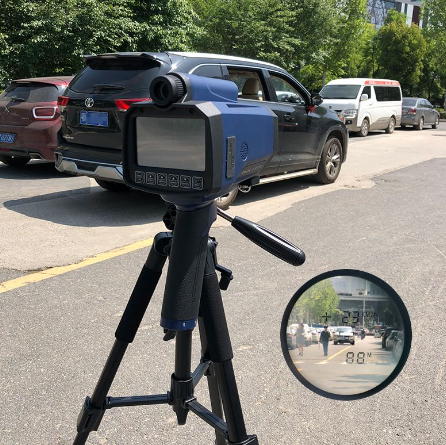
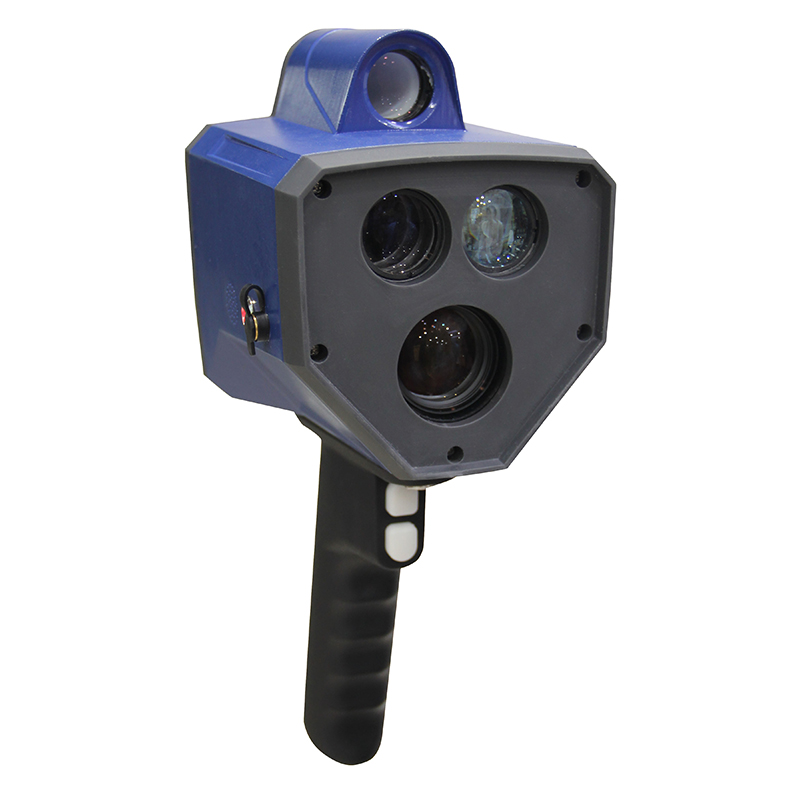
A handheld laser speed meter (or laser speed gun) is a portable device that uses laser ranging technology to accurately measure the speed of moving targets. Due to its high accuracy, strong directivity, and good anti-interference capabilities, this type of instrument is widely used in traffic enforcement, road safety management, vehicle testing, and scientific research measurements.
Compared to traditional radar speed guns, handheld laser speed guns can accurately lock onto a single target and maintain reliable speed measurement results even in multi-vehicle environments, making them an important technical means for modern traffic speed measurement.
Working Principle:
Handheld laser speed guns are primarily based on the time-of-flight (TOF) principle of laser pulses, supplemented by distance change calculations to achieve speed measurement.
1. Laser Ranging Principle: The instrument emits a high-frequency, short-pulse infrared laser beam towards the target. When the laser shines on the surface of the moving target (such as a vehicle), it is reflected back to the receiver. Internally, the instrument precisely times the laser's round-trip time from emission to reception, thus obtaining the distance between the target and the instrument.
The calculation formula is as follows: Distance = Speed of Light × (Round Trip Time ÷ 2)
Due to the constant speed of light and extremely high timing accuracy (nanosecond level), laser rangefinders have extremely high accuracy.
2. Speed Calculation Method
Handheld laser speedometers do not measure distance only once, but continuously measure multiple sets of distance data within a very short period. By calculating the change in distance per unit time, the target's speed can be obtained:
Speed = Change in Distance ÷ Change in Time
This method enables precise measurement of the instantaneous speed of vehicles.
Key Technical Features
1. High-Precision Speed Measurement
Speed measurement accuracy typically reaches ±0.5 km/h or higher.
Short measurement time, stable and reliable results.
2. Narrow Beam Pointing
Extremely small laser divergence angle, allowing precise targeting of a single vehicle.
Less prone to misjudgment in multi-vehicle or complex traffic environments.
3. Long-Distance Measurement Capability
Effective speed measurement distance can reach hundreds to thousands of meters.
Suitable for highways, urban expressways, and other scenarios.
4. Portable Design
Handheld or tripod use.
Facilitates mobile enforcement and temporary deployment.
5. Multifunctional Integration (High-End Models)
High-definition camera or video evidence collection
GPS positioning and time recording
Data storage and export functions.
Typical Application Scenarios
1. Traffic Enforcement
Used to detect speeding by motor vehicles, obtain accurate speed data, and cooperate with video evidence collection to improve the fairness and standardization of enforcement.
2. Road Safety Management
Used for speed monitoring around schools, accident-prone sections, or temporary control areas to assist in the formulation of speed limits and safety measures.
3. Vehicle Performance Testing: Used in automotive research and development, testing, or racing to test vehicle acceleration performance and speed.
4. Scientific Research and Teaching: Used for kinematic experiments, teaching speed measurement principles, and engineering testing.
Summary
The handheld laser speedometer is a high-precision, high-reliability modern speed measuring device. Through laser ranging and high-speed data processing, it accurately measures the speed of moving targets. Due to its accuracy, portability, and good target recognition capabilities, it has been widely used in traffic enforcement and professional speed measurement fields and is gradually becoming the future direction of speed measurement technology.